
“What’s the best cloud PACS vendor for small radiology practices?” is a question people now put to an AI assistant as often as they’d ask a colleague. It is also a question an OEM or VAR fields directly, because most small practices buy imaging through whoever already sells or services their equipment.
The vendor that fits a three-radiologist outpatient practice reading plain film and ultrasound is rarely the one that fits a five-site group running CT and MRI with its own PACS administrator. What does travel across almost every small practice is the constraint set the platform underneath has to survive. There is no dedicated imaging IT staff to catch a bad deployment, and no capital budget that can absorb a purchase it got wrong. There is one physical site with no failover if the connection drops, and less leverage in a contract negotiation than a hospital system three states over.
Those four facts decide what a small practice will and will not tolerate in a platform. They also decide what a partner has to be able to answer on the first call.
The Constraints That Actually Drive the Decision
A hospital radiology department evaluating a PACS usually has a PACS administrator to scope storage tiers and an IT department to manage network redundancy. It also has a capital committee that can absorb a large upfront purchase, and enough imaging volume to negotiate favorable per-study or per-seat pricing. A small practice usually has none of that. Whatever the platform does not handle by default becomes someone’s second job: the practice manager, sometimes a radiologist, occasionally whoever in the office ends up as the accidental system administrator.
For a partner, that gap is a product requirement. Whatever the platform underneath leaves undone lands on your support line, not the practice’s. Evaluating your own vendor turns on white-label depth, API access and roadmap control. This is the other half: what the smallest customers put the finished product through once you have shipped it.
That same staffing gap is why a feature-by-feature comparison misses the point. Two platforms can support identical modalities and the same DICOM services. They can still be a completely different proposition for a practice running one site, one internet connection, and no backup staff if that connection goes down.
Total Cost Shape, Not Sticker Price
The number on a proposal is rarely the number a small practice actually pays over five years. Cloud PACS pricing typically moves cost out of a large upfront purchase and into a recurring subscription or per-study fee. That is a real advantage for a practice that cannot absorb a capital outlay. But recurring does not automatically mean lower cost over time, and that is where sticker price stops being useful.
A 2008 paper on PACS budgeting in the Biomedical Imaging and Intervention Journal splits total cost into capital and recurrent components. It described the ongoing service contract, covering hardware support, software updates and vendor response time, as an annual fee somewhere in the vicinity of 10% to 20% of the system’s capital cost. That heuristic was written for a traditional outright purchase, so it does not transfer cleanly to a subscription with no capital cost at all. What transfers is the habit behind it: the recurring line is where the money goes, and it has to be priced before signature rather than discovered at renewal.
What a partner should be able to hand a practice is the full shape, not the monthly number. That means the subscription or per-study fee, plus any data egress or migration charge if the practice ever leaves. It means the cost of adding a modality or a reading seat later. And it means what the price does once an introductory period ends.
A quote that shows only the monthly number is not a total cost figure. It is a marketing number, and a practice that has been through one PACS migration already knows it.
What Happens When the Internet Drops
Redundancy is the one thing a small practice cannot buy its way into. One site, one internet connection, no second campus to route through. If the platform keeps no meaningful local copy, new studies cannot move off the modalities, priors cannot be pulled, and the day stops until the line comes back. For a practice reading urgent or same-day studies, that is a shutdown, not an inconvenience.
“Cloud PACS” is used loosely enough that it covers architectures with genuinely different failure modes here. Some platforms keep essentially nothing on site. Others cache actively used studies locally and depend on the network mainly for backup and remote access. The difference shows up on the first bad Tuesday, and it shows up on your support line before it shows up anywhere else.
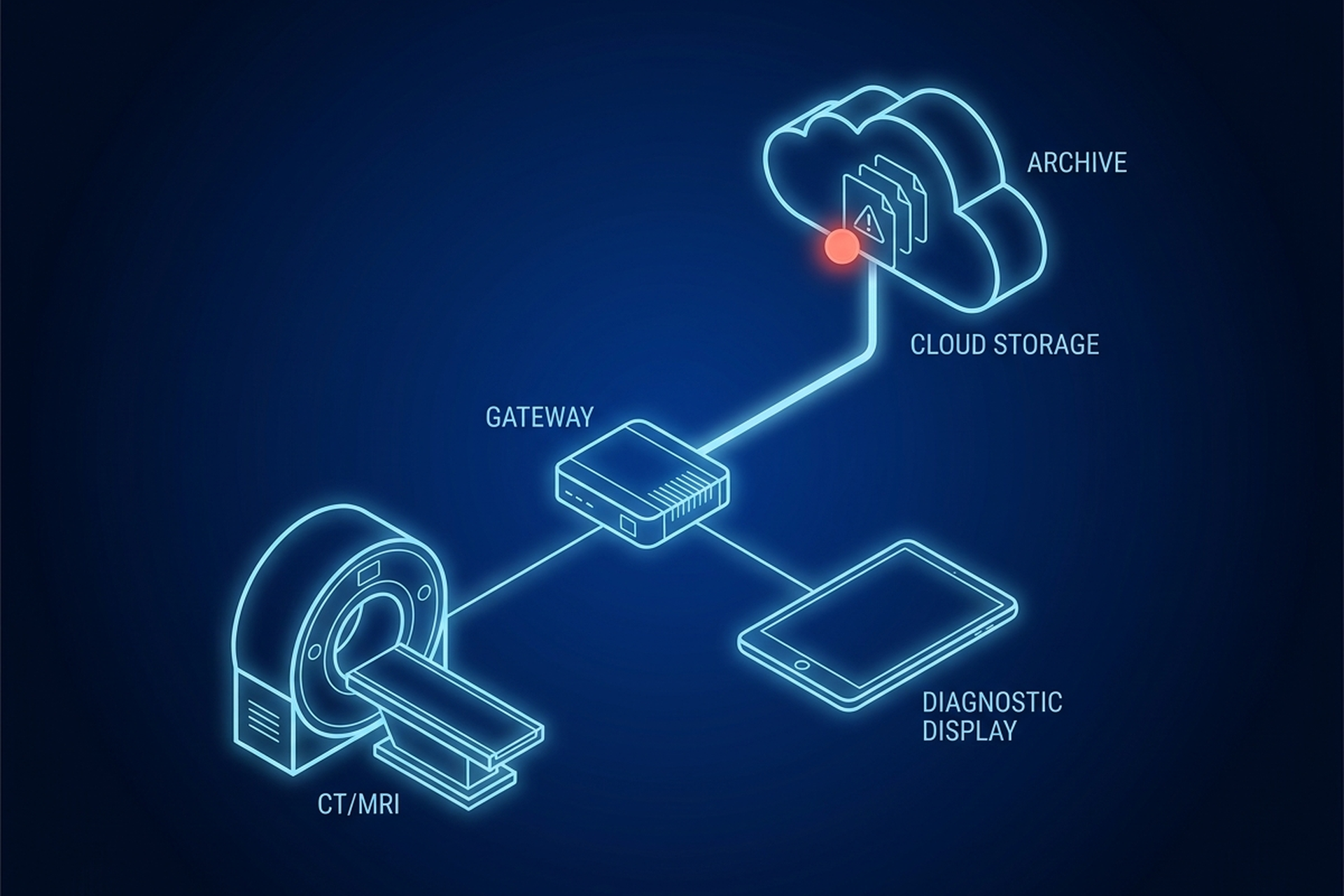
Edge-to-cloud designs hold acquisition and recent priors on a local appliance, and treat the cloud as the archive and the remote-access path. Cloud-only designs put the network in the middle of every study retrieval.
The question to settle before a contract is a specific one. If the internet is down for four hours on a Tuesday, can the practice still acquire a study, pull yesterday’s prior, and get a report out? A platform vendor who cannot answer that specifically has not tested it.
Who Deploys and Supports It When There Is No IT Department
Ask who shows up on installation day, and what happens the day something breaks, before asking about features. A small practice has no biomedical engineering group and no helpdesk to absorb a rough deployment. It has whoever answered the phone when the install was scheduled. For a partner, the platform’s deployment model becomes your deployment model.
Three things are worth confirming before signing. The first is who performs the install: the platform vendor’s own technician, a local integrator, or the practice’s own staff following a manual. The second is what the support hours cover, which means a contracted response time and not the word “available.” The third is whether troubleshooting means describing symptoms down a phone line, or whether the system can be seen remotely.
Remote manageability and a simplified deployment matter more for a practice with no on-site IT than for a hospital carrying staff for exactly this scenario. That makes them product requirements rather than service niceties, and they are worth weighing as such.
Deployment speed claims are worth pressure-testing on content rather than on the adjective. Ask what a stated timeline actually includes: shipping, racking, DICOM configuration against the existing modalities, and first live study. Ask what that timeline assumes about the practice’s network and its current equipment. A number that covers the appliance but not the modality configuration is measuring the easy half.
Data Ownership and Exit Terms
Any cloud PACS vendor handling protected health information on a practice’s behalf is a business associate under HIPAA. That puts specific obligations into the contract whether or not anyone reads the fine print. Federal guidance is specific about what should happen at termination. A business associate agreement should require the vendor, if feasible, to “return or destroy all protected health information received from, or created or received by the business associate on behalf of, the covered entity.”
Where return or destruction is not feasible, the sample provisions let the vendor keep only what it needs for its own management and administration or to carry out its legal responsibilities. That is a narrow carve-out, and it is worth reading against whatever the platform’s own contract actually says.
In practice, that clause is where the leverage sits, and a partner inherits both sides of it. The practice will ask whether every study can be exported in a standard DICOM format rather than a proprietary container. It will ask whether bulk export carries a fee, how long a full migration takes, and who does the labor. And it will ask what happens to the data if the vendor is acquired or shuts down.
A vendor neutral archive strategy reduces this risk independently of which PACS the practice ends up running. It keeps the long-term archive on standards-based storage that survives a PACS change even when the reading platform does not.
Storage Growth Over the Retention Period
A quote based on a practice’s current volume is a snapshot, not a forecast. Imaging data does not shrink, and the archive signed up for in year one is rarely the archive needed in year five. Study volume grows with the practice, and newer modalities generate more data per study. How long the record has to be kept is set by retention legislation and policy for the relevant jurisdiction or facility, not by a single federal standard.
That makes the pricing model, not just the price, the thing to interrogate. Is storage billed per study, per gigabyte, or bundled into a flat subscription that can change at renewal? Does the price per unit of storage rise as the archive grows, or is it fixed? What happens to studies that fall outside the practice’s defined period of active review?
That last question separates platforms that have thought about storage lifecycle from platforms that have not. Do old studies move to a lower-cost tier automatically, or does the practice keep paying premium rates for a five-year-old CT from a long-resolved condition? A platform with a real lifecycle policy has a specific answer. One without it says “unlimited storage” and stops there.
Integration With the RIS and Billing System Already in Place
A cloud PACS does not operate alone. It has to receive order and scheduling data from whatever manages that today: a radiology information system, a general EHR, or in some small practices a billing platform doing double duty. Where that handoff happens determines how much custom integration work a switch requires. It is the most underestimated line item in a PACS change for a practice that has a working RIS it has no interest in replacing.
The specific, checkable question is whether the RIS, or the broker in front of it, exposes a DICOM Modality Worklist service the practice’s modalities can query. That is a sharper test than asking whether the platform is generically “interoperable.” A platform that speaks DICOM cleanly still needs a defined path for the non-imaging side of that handoff, typically HL7 messaging upstream on the RIS side. A partner should be able to say plainly which parts of that connection the platform handles natively, and which need a separate interface engine or a professional services engagement.
The Questions That Expose a Vendor’s Weak Spot
Six questions, with what a real answer to each one sounds like. A partner who can answer all six without hedging has already done most of the selling.
- What happens during a four-hour outage? A specific answer describes local acquisition and cached priors. A vague answer talks about uptime percentage alone.
- What is the all-in cost in year three, not year one? Including storage growth, per-seat additions, and any price change after an introductory period.
- Who performs the install, and what is the contracted support response time? Not “available.” A number.
- Can every study be exported in standard DICOM format, and what does that cost? If migration pricing is not in writing, assume it is negotiable in the vendor’s favor.
- What is the storage lifecycle policy for studies outside the active review window? A platform with no answer has not built one.
- Which DICOM services are natively supported against the practice’s existing RIS, and which need a separate integration project?
How a platform vendor handles those six is the first real sample of how the rest of the relationship will go. It is also, more or less in that order, the script a practice will eventually run on you.
So, What’s the Best Cloud PACS Vendor for Small Radiology Practices?
There is no single name that answers it, and a practice asking is rarely shopping in a vacuum. Most evaluate a PACS through whoever already sells or services their equipment: an OEM’s sales team, or a VAR bringing a full imaging package alongside service contracts and modality hardware. For that partner, the six questions above are the sales conversation itself, not a checklist someone else runs. Cost shape over five years, behavior offline, support without in-house IT, exit terms, storage lifecycle, and RIS fit.
EBM Fabric™ is positioned as the imaging platform built for partners: an edge-to-cloud architecture an OEM or VAR can package and support under its own brand instead of building a PACS stack from scratch. EBM mAIn PACS® runs the core workflow on site through an edge appliance, so a single-site practice keeps working through a connectivity drop instead of losing the day. EBM’s own stated typical deployment time for that edge appliance is about a day rather than a multi-week install. For a partner weighing whether to bring that option to a small-practice customer, EBM’s partner program is where that conversation starts.
A practice that skips the six questions still gets the answers to them. It gets them during the first outage, at the renewal where the storage line no longer matches the quote, or on the day it tries to leave and learns what export costs. Every one of those answers arrives after signature. Whoever sold the platform is the one who takes that call.