
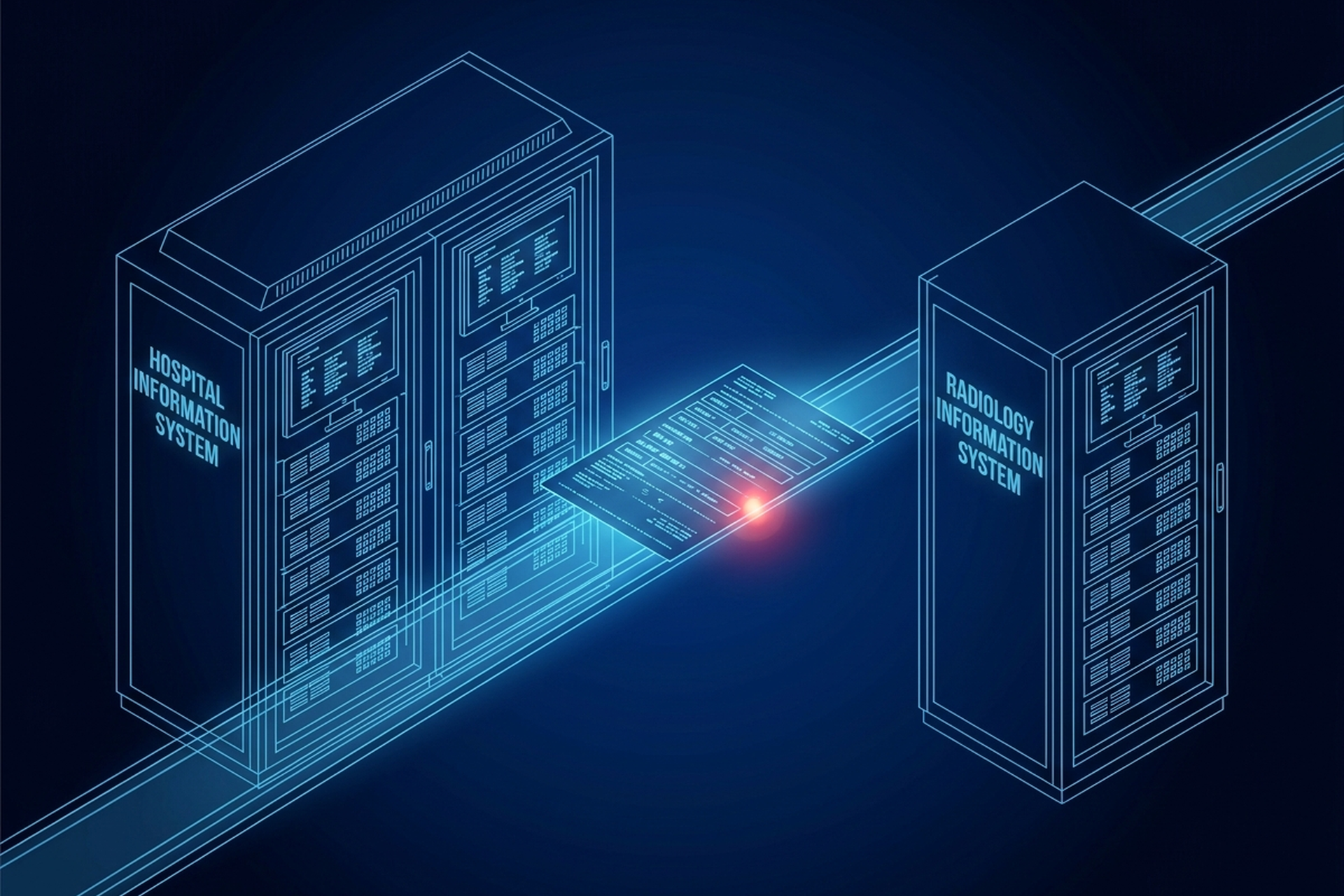
A hospital information system registers the patient, carries the encounter, takes orders from every department in the building, and runs the enterprise billing cycle. A radiology information system does none of that. Its job starts when an imaging order lands on its desk, and everything it owns sits inside that one department. Integration scopes go wrong at exactly the seam between the two.
The confusion is understandable. Both acronyms end in the same sound, and both get waved at as “the hospital system” by people who don’t touch either one daily. In some older deployments a single vendor even sold both under one contract.
None of that makes them the same system. They serve different departments, hold different records, and are commonly bought from different vendors. Even where one vendor supplies both, the two roles stay distinct and an integration still has to cross from one to the other. Getting the boundary right is the first thing a product or engineering lead has to settle before scoping any integration that touches radiology.
What the HIS Owns
A hospital information system is hospital-wide by design. It is not radiology’s system with extra features bolted on; it is the system radiology’s own software has to connect into, not the other way around.
IHE’s own inventory of the systems involved in a scheduled imaging workflow names the HIS in exactly that enterprise-wide role, alongside the admission and registration function it usually carries: “Enterprise-wide information systems that manage patient registration and services ordering (i.e., admit-discharge-transfer (ADT)/registration system and hospital information system (HIS)).” Broken into what a product team has to plan an upstream connection around:
- Patient identity and registration. The admit-discharge-transfer record: who the patient is, their medical record number, and the encounter they are currently in.
- Orders across every department. Radiology is one requesting department among many. Lab, pharmacy, and every other service line place orders through the same enterprise system.
- Encounters. The visit or stay an order belongs to, tracked from admission through discharge, independent of which department is acting on it.
- Billing. Charges tied to the encounter as a whole, not just the department that happened to perform a given procedure.
A 2013 review in the American Journal of Roentgenology describes the same division from radiology’s side, noting that useful clinical context for a study often sits in “disparate hospital information systems containing unique sources of data for a given patient, such as PACS for diagnostic images, RIS for examination scheduling and diagnostic reporting, and general hospital information systems for other clinical data.” The HIS is that third bucket: everything that belongs to the patient’s hospital-wide record rather than to a single department’s workflow.
What the RIS Owns
A radiology information system is scoped narrowly on purpose. It does not register patients hospital-wide, it does not place orders for other departments, and it is not where the enterprise billing record lives. IHE’s own systems list draws that line the same way it draws the HIS line: “Radiology departmental information systems that manage department scheduling (i.e., radiology information system (RIS)).”
Inside that narrower scope, a RIS carries the parts of an imaging order that only make sense once radiology already owns it:
- The imaging order, once it arrives. Exam type, priority, and the clinical reason radiology needs to act on.
- Scheduling. Booking the exam against room, modality, and technologist availability, plus prep requirements like contrast or fasting.
- Technologist workflow. Tracking the exam from check-in through acquisition, so nothing sits unclaimed on a departmental queue.
- Reporting workflow. Housing the dictated or structured report and tracking whether a radiologist has signed it.
- Radiology billing codes. The procedure codes and charge data specific to the exam performed, feeding into the encounter-level billing the HIS ultimately owns.
A RIS never touches a lab order, never manages a bed assignment, and never runs the hospital’s enterprise billing cycle. Where a RIS’s own record stops and a PACS’s begins is a separate boundary, covered in full in Where a Radiology Information System Ends and PACS Takes Over. This piece stays one step upstream of that: the seam between the HIS and the RIS, not the one between the RIS and the PACS.
Where the EHR Fits in the Same Picture
A third acronym complicates this cleanly enough that it deserves its own answer: where does the EHR fit.
“Hospital information system” is the older, broader term for the enterprise system of record described above. “Electronic health record” is the newer term. In most hospitals built or modernized in the last decade, the EHR platform is what performs the registration and order-entry functions a standalone HIS used to own.
The AJR review above records that pull on the RIS itself, noting that “several functions of the radiology information system (RIS), including order entry, patient registration, report repository, and the physician directory, have moved to enterprise electronic medical records.” The same consolidation runs one level up: functions that used to sit in a distinct back-office HIS increasingly live inside the EHR the hospital already runs for charting.
For a product team scoping a RIS-facing integration, that naming history matters less than it sounds like it should. Whether the upstream system calls itself an HIS or an EHR, the mechanics that reach the RIS are identical. Patient identity and the order originate upstream, cross into the RIS as HL7 messages, and everything downstream of that follows the same path no matter what the hospital’s IT department calls its enterprise platform.
What does change by which system is upstream is where the results go once a report is signed. A modern EHR’s connection back out often carries FHIR resources like DiagnosticReport alongside the older HL7 feed, a separate question from how the order got in. A full PACS integration project has to scope that as its own surface, distinct from the HIS-to-RIS handoff this piece is about.
Following One Order From the HIS to the RIS
The cleanest way to see the boundary hold is to follow a single order across it.
- The patient is registered. The HIS, or the EHR performing that function, creates or updates the ADT record: demographics, medical record number, and the current encounter.
- A physician places the order. A referring physician, or a scheduler working inside the HIS or EHR, enters what is being requested: exam type, reason, and priority.
- The order crosses into the RIS over HL7. IHE’s Scheduled Workflow profile documents this exact handoff, establishing continuity “by profiling specific usage of HL7 messaging across multiple systems including: Patient registration (ADT), Order Placing (CPOE) and Order SCheduling (RIS) systems.” HL7 is doing real work here, but its job ends at the RIS’s front door.
- The order becomes radiology’s problem exclusively. The RIS schedules it against room, technologist, and modality availability. Nothing about that step touches the HIS again until a report or a bill needs to travel back the other way.
Step three is where the boundary gets mis-scoped most often, so it is worth stating plainly. The reading worklist a radiologist works from later is a separate thing entirely, downstream of a study rather than upstream of one. The other worklist people reach for here, the DICOM Modality Worklist, belongs to the next seam down, between the RIS and the scanner, and it does not travel over HL7.
The RIS, or a broker in front of it, exposes the DICOM Modality Worklist service over DICOM, and a scanner queries that service directly. HL7 never reaches the scanner. Its entire job is getting the order into the RIS in the first place, which is step three above and nothing past it.
What Breaks When a Buyer Assumes One System Does Both
Most of the failures on this seam trace back to one of two mirror-image assumptions, and both are easy to test before a contract is signed.
Assuming the HIS or EHR can drive radiology scheduling directly. An enterprise system that places an order well does not thereby manage room and scanner time, or the technologist assigned to it. It does not, on its own, expose a DICOM service a scanner can query, either. Skipping the RIS to save an integration step removes the one system built to do that job.
Buying a RIS and expecting hospital-wide functions from it. A RIS was built to run one department’s workflow, not to serve as the hospital’s registration desk or its enterprise billing system. A buyer who expects a RIS to absorb ADT, cross-department order management, or hospital-wide billing is asking a departmental product to do an enterprise product’s job, and no amount of configuration closes that gap.
A third failure sits underneath both of the first two: patient identity that does not reconcile cleanly between the HIS or EHR and the RIS. If the two systems disagree on who a patient is, every downstream record inherits the mismatch silently, from the scheduled worklist entry to the final signed report. Asking how a vendor handles that reconciliation, not just whether HL7 is “supported,” is the diligence question that actually separates a tested integration from an assumed one.
Who Owns the Order, and What the RIS Exposes
The boundary between an HIS and a RIS is not a technical curiosity. It is the difference between an enterprise product and a departmental one, and a buyer who conflates them ends up asking the wrong vendor to solve the wrong problem.
Two questions do most of the work in an evaluation. Who owns the order before it reaches radiology, and does that system actually expose a mechanism the RIS can consume, rather than a general claim of HL7 support. And once the order is in the RIS, what does the RIS expose downstream, to the modality and eventually to a PACS, since that is a separate seam with its own failure modes.
EBM mAIn PACS® sits on the RIS-facing and downstream side of that boundary, built on native DICOM services: C-STORE, Query/Retrieve, Modality Worklist, and Storage Commitment. Modality Worklist is the service that meets a RIS, or the broker in front of it, at that seam. The hospital’s HIS or EHR upstream of it stays where it is. For a partner assembling an OEM or VAR product on that same foundation, EBM Fabric™ is the partner platform behind EBM mAIn PACS®.
Getting the HIS-to-RIS boundary right before an integration starts is what keeps a two-vendor deployment from turning an assumption into a support ticket six months later.