
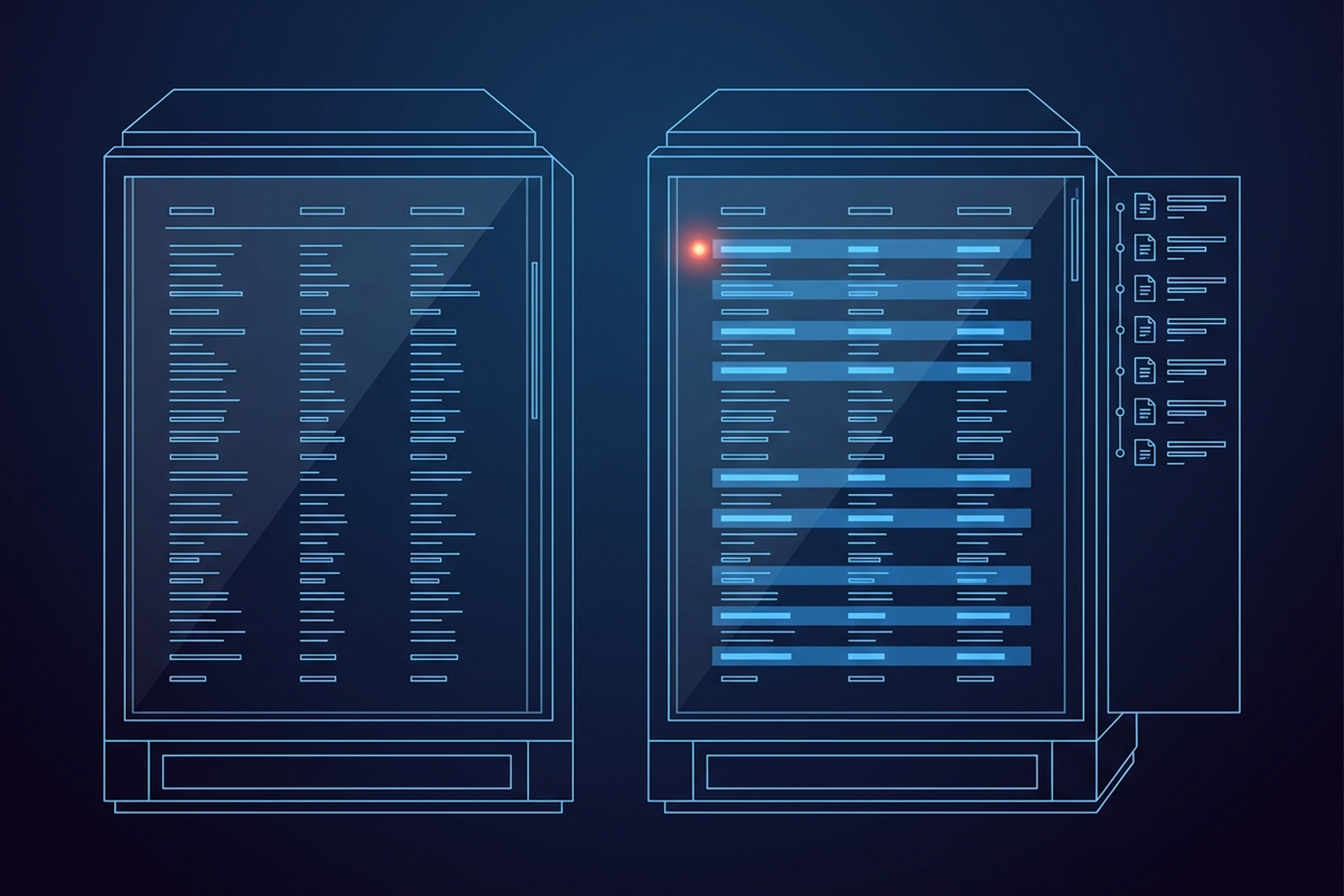
Search “DICOM anonymizer software” and almost every result calls itself an anonymizer, not a de-identifier, because that is the word the market uses. DICOM de-identification already draws that line in full. De-identification is the defined technical process of removing or replacing specific elements; anonymization is the stronger claim that nothing left in the object can lead back to the patient. Most tools sold as anonymizers are de-identification tools wearing the name buyers search for.
That distinction is worth knowing before you read a spec sheet, but it is not the question this article answers. The question here is narrower. Once every vendor calls its product an anonymizer, how do you choose one you could actually defend to an IRB, a privacy officer, or a regulator asking what you did and why?
Why a Feature List Can’t Separate Two DICOM Anonymizer Software Tools
“Removes PHI” and “HIPAA-ready” appear on nearly every product page in this category, and they describe the goal, not the implementation. Two tools carrying identical marketing copy can produce different output from the same study. The gap between “de-identifies” and “de-identifies correctly” lives in engineering decisions a feature list never mentions. It shows up in which attributes get touched, how consistently, and what happens to the parts of a study that are not attributes at all.
A 2024 de-identification methods paper cites a comparison that put this to the test. Researchers ran free DICOM toolkits against a defined set of fifty attributes with the potential to carry patient identity. Only two performed well on their default settings. The rest needed hand-tuned configuration, where the tool even supported it, before reaching an acceptable result.
A page that says the product removes PHI is silent on all of that variation. It shows up when someone tests the output, which is the first criterion worth applying to any candidate. Has anyone, including you, checked what the tool actually did to a real study, or only what the vendor says it does?
The Confidentiality Profile and Its Eleven Options
DICOM does not leave “de-identify a study” undefined. PS3.15 Annex E specifies a Basic Application Level Confidentiality Profile, the base set of attribute actions every conforming de-identifier applies, plus eleven named Options layered on top of it. The standard is explicit about why options exist separately from profiles: they exist “to prevent a combinatorial expansion of different Profiles.”
A tool does not have to implement every option to be useful. It has to implement the ones your use case needs, and the ones it skips are exactly what a buyer has to ask about by name. The profile itself, and the options that most often decide that conversation:
| Profile or Option | What it governs |
|---|---|
| Basic Confidentiality Profile | The baseline attribute actions every conforming tool applies |
| Clean Pixel Data | Text burned directly into the image itself |
| Clean Graphics / Clean Structured Content | Overlays, annotations, and report content outside the pixel array |
| Retain Safe Private | Whether private, vendor-defined tags are evaluated and selectively kept, rather than passed through unexamined |
| Retain UIDs | Whether original identifiers are kept instead of replaced, for a narrower audit case |
A vendor’s own conformance statement is supposed to say which of these it claims. DICOM’s normative Conformance Statement Template reserves a specific table for exactly this. Table N.1-14 lists every de-identification profile and option the implementation supports, and instructs the vendor to mark the section not applicable if it supports none. If a vendor cannot point you to that table, filled in, the honest read is that nobody has been asked to fill it in yet.
UID Remapping: Consistent Within a Study, Reversible Only By Design
Every DICOM object carries UIDs that tie a study to its series and its individual images. Why those get remapped instead of deleted is already covered elsewhere; what matters for tool selection is what “correct” remapping requires.
The standard’s own action code for this is blunt about what “correct” means: a replaced UID has to be “a non-zero length UID that is internally consistent within a set of Instances.” That consistency is scoped to one processing run across one study’s instances, not a promise that a second run of the same study produces the same replacement values. Whether a tool’s mapping is stable enough to reprocess an amended series and land on the same identifiers is a separate, practical question worth asking directly, because the standard does not require it.
Recovering the original identity later is a related but distinct capability. DICOM gives it a specific, defined mechanism rather than leaving it to convention: an Encrypted Attributes Data Set that carries the original values, retrievable only by whoever holds the decryption key. The mechanism uses RSA key transport with AES or Triple-DES content encryption, the same construction a keyed pseudonym scheme would use outside DICOM.
A tool that claims reversible, keyed de-identification should say which approach it uses: this standard mechanism, or a proprietary lookup table kept outside the object. The second approach puts the mapping’s security entirely on how that table is stored and who can reach it.
Pixel Data and Private Tags: the Two Places a Tag List Doesn’t Reach
Two failure modes account for most of the gap between “removes PHI from the header” and “removes PHI.” The first is burned-in text written directly into the pixel data, most common on ultrasound and secondary capture images, which an attribute-only pass never touches. The second is private, vendor-defined tags, which DICOM’s own attribute table does not claim to cover exhaustively. A conforming Basic Profile implementation only has to act on the attributes the standard lists.
Whatever a specific scanner vendor invented outside that list is the de-identifier’s problem to find, not the standard’s to define for it.
Ask a vendor to show, not describe, both cases. Run their tool on a study from a modality known to burn in text, and compare before and after. Then ask for a study carrying private tags from a real scanner, with a statement of which ones were evaluated and which were passed through unexamined.
A Per-Study Record, Not a General Claim
A conformance statement describes what a product can do in general. It says nothing about what happened to the specific study a compliance officer is being asked about six months from now. DICOM addresses that gap with an attribute made for the purpose.
Once a conforming de-identifier finishes, it sets Patient Identity Removed (0012,0062) to YES. It also records what it did in De-identification Method (0012,0063), in De-identification Method Code Sequence (0012,0064), or in both, naming the profile and options actually applied to that object.
A tool that populates this correctly hands you a record attached to the study itself: proof of what ran, not just a claim about what the product is capable of in the abstract. A tool that leaves it blank, or writes a generic string regardless of which options ran, gives you nothing to point to when someone asks what happened to a specific file.
What This Means for Your Evaluation
Every criterion above is an ordinary question with a documented answer. Ask which profile and options a candidate implements, and check the answer against a filled-in Table N.1-14, not a marketing paragraph. Ask whether UID replacement stays consistent within a study, and how identity recovery works: keyed and encrypted, or an external table.
Ask directly whether pixel data and private tags are touched at all, and ask to see it on a real study rather than take the claim. Ask whether the tool writes a per-study record of what it did, or only a general statement of what it is designed to do. Then validate the output yourself: the research on free toolkits above is a reminder that a tool’s stated behavior and its actual behavior are two different things until somebody checks.
Whatever de-identification step runs upstream, the resulting study still has to move through the same DICOM services as any other object once it reaches an archive. It gets stored, queried, retrieved, and related back to its own series using the identifiers that step just rewrote.
EBM mAIn PACS® implements native DICOM C-STORE, Q/R, MWL and Storage Commitment against that documented services list. The platform’s posture is designed to support HIPAA compliance, alongside whatever de-identification discipline a partner runs before a study reaches it.
Defensibility is not a feature a vendor can claim on your behalf. It is what is left after every question above has an answer on the record, not just in the pitch.