
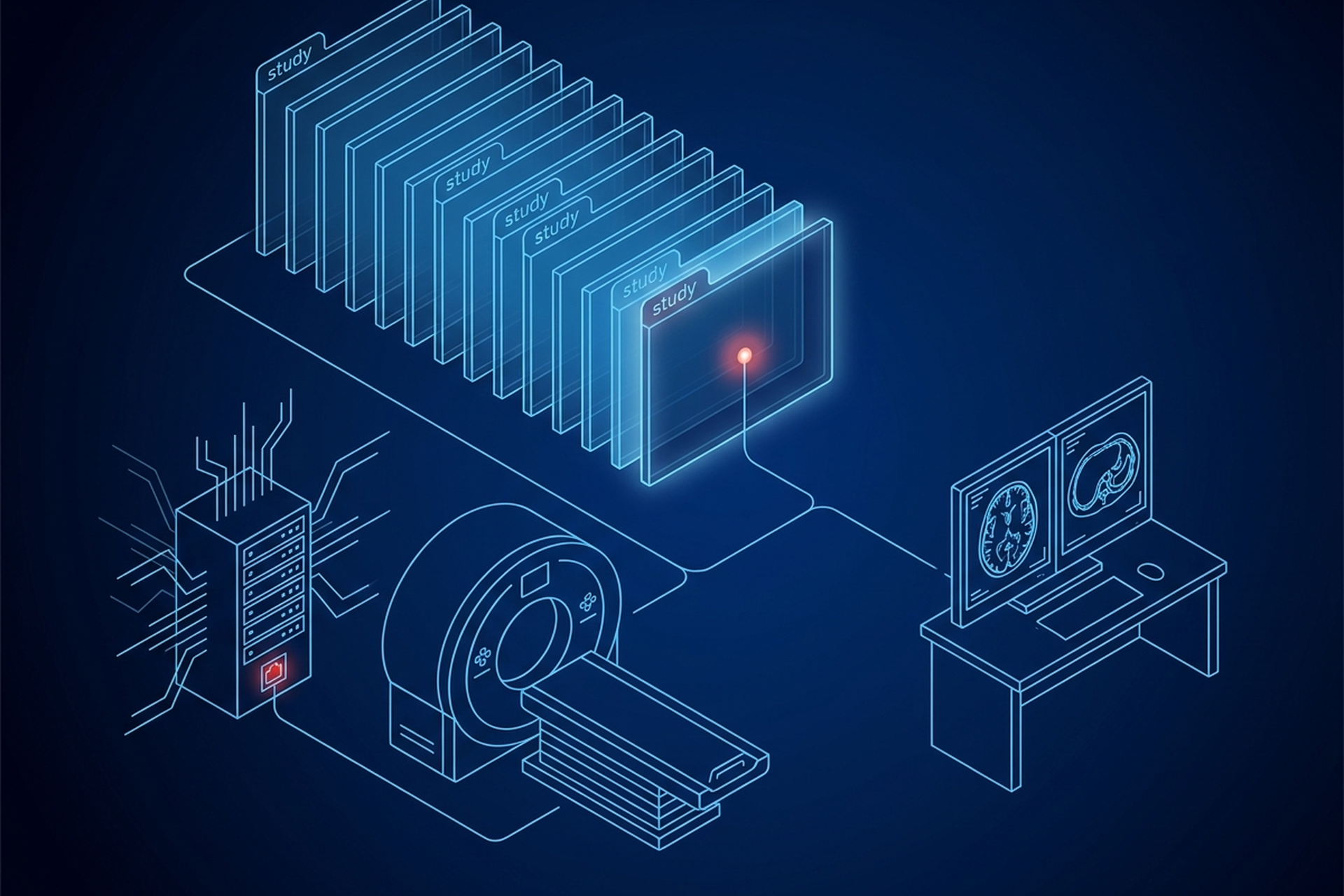
A radiology worklist is where turnaround time actually gets won or lost. Not at the scanner, not in the archive: at the queue that decides which study a radiologist opens next, in what order, and whether it lands in front of the right reader at all. A well-built worklist is invisible, because studies simply show up where they belong.
A badly built one fails silently. Nothing crashes. A study just gets read out of sequence, or sits in the wrong queue, and nobody sees an error because there isn’t one to see.
This piece is about that queue specifically: what it holds, where its data comes from, how it decides who reads what and in what order, and what quietly breaks in the logic underneath.
What the Reading Worklist Actually Holds
A reading worklist entry is not the study itself. It is a reference to one.
The entry carries an accession number and patient identifiers tying it back to the correct exam, plus the modality and body part that shaped how it should be triaged. Beyond that, the entry holds a priority level and a status: unread, claimed, in progress, preliminary, or final. In most deployments it also names an assigned reader or reader pool.
None of that data originates inside the worklist. The worklist assembles it from elsewhere: the study’s own DICOM metadata once it lands in the archive, plus scheduling and priority information carried over from the order. Assignment rules come from the department, not the vendor. A worklist is a view built on top of other systems’ data, which is exactly why getting the underlying handoffs right matters more than the queue’s own interface.
Not the Same Thing as the DICOM Modality Worklist
The reading worklist is not the DICOM Modality Worklist, MWL, and the two get confused often enough that the distinction is worth stating plainly.
MWL feeds a scanner its scheduled-exam data before acquisition. It’s how a CT or MRI gets a patient’s identifiers, procedure description, and accession number without a technologist typing them in by hand. That work happens upstream, before a single image exists.
The reading worklist sits downstream of that, after a study has already been acquired and stored. It doesn’t feed a scanner anything. It tells a radiologist what to read next. Different service, different point in the pipeline, different system usually responsible for it.
The two get conflated for an understandable reason: both are called “worklists,” and both exist to remove manual lookup from someone’s job. But a vendor who cannot tell you cleanly which one their product handles, or claims one system covers both without describing the mechanism, hasn’t actually described their architecture.
How an Order Becomes a Worklist Entry
An order does not arrive at the reading worklist directly. It has to cross the same seam every scheduled exam crosses, and the ownership of that seam is easy to get backwards.
The RIS, or a broker in front of it is what exposes the scheduled procedure as a DICOM Modality Worklist entry, the thing a scanner queries before acquisition. HL7 is not what publishes that worklist entry. HL7 does its work earlier, carrying the order into the RIS in the first place, from a referring physician, an EHR, or a scheduler working inside the RIS itself. Once the order is in the RIS, the RIS (or its broker) is the one that makes it visible to a modality over DICOM, not over HL7.
A second and separate handoff happens only once a study exists (acquired, sent, and archived). The study gets matched against a reading worklist entry so it shows up in the correct reader’s queue instead of a flat, undifferentiated list. That second handoff is where a PACS and a RIS meet over the study rather than the order, with the accession number as the key that matches one to the other.
Two separate crossings, two separate mechanisms: DICOM Modality Worklist on the way to the scanner, accession-number matching on the way to the reader. The RIS (or its broker) owns the first, the reading worklist owns the second, and the correct study reaches the correct reader at the correct time only if both hold.
Assignment Logic: What Actually Routes a Study to a Reader
A flat worklist, sorted by arrival time, is the easiest thing to build and the first thing every vendor demo shows working. It is also the version that breaks down the moment a department has more than one reader or more than one kind of study.
Real assignment logic routes on a combination of signals, not one:
- Modality. A chest X-ray and a cross-sectional CT don’t carry the same reading time or the same credentialing requirement, and a worklist that treats them identically forces a manual sort a reader shouldn’t have to do.
- Subspecialty. A neuro study belongs in front of a reader credentialed to read it, not the next available person in line. Subspecialty routing depends on the worklist knowing what a study is, from its modality and body part metadata, and knowing what each reader is qualified to open.
- Priority. STAT, urgent, and routine studies cannot share one FIFO queue without the routine studies burying the urgent ones the moment volume climbs.
- Load. A worklist that assigns every incoming study to whichever reader logged in first, rather than balancing against how many open studies each reader already carries, produces the same bottleneck a single overloaded queue would, just distributed across more people.
None of these signals is exotic on its own. What separates a real assignment engine from a flat list is whether it combines them automatically, on every study. The alternative is a human re-sorting the queue by hand, once volume gets high enough that a plain arrival-order list stops working.
How STAT and Urgent Studies Jump the Radiology Worklist Queue
Priority only means something if it changes where a study lands, not just what label it carries.
A properly built worklist treats a STAT flag as an interrupt, not a tag. The study moves to the front of the relevant reader’s queue immediately. In a well-designed system that arrival can also trigger a notification, an alert to the assigned reader or a supervising radiologist, rather than depending on someone noticing the flag while scanning down a list. The flag has to survive the whole trip, from the ordering physician, through the order into the RIS, to the reading worklist, still attached and still correctly interpreted.
The gap a prioritizing worklist closes is not theoretical. Plain first-in, first-out worklists, the default when no prioritization logic is layered on top, do not account for clinical urgency, and that can stretch how long a study waits. A worklist that reorders automatically by urgency, rather than depending on a reader to notice a flag in a flat list, is solving exactly that problem.
Worklist Behavior Across Multiple Sites and Time Zones
A single-site worklist is a queue. A worklist covering more than one acquiring site, more than one reading location, or a coverage schedule that spans time zones has to do more than sort.
It has to route across sites, sending a study to whichever reading pool is actually staffed for it right now, not just the site where it was acquired. It has to hand off automatically as coverage changes, an overnight or weekend reader picking up a region’s queue without someone manually reassigning cases as a shift ends. And it has to keep subspecialty and modality routing intact across that handoff, so a study that needed a neuro reader at 6pm still needs one at 2am, regardless of who is covering.
The failure mode in a multi-site worklist is rarely total. It is a handoff that runs late, or a routing rule tuned for one site’s reader roster that doesn’t carry over cleanly to the site covering after hours. Both look identical to a working system until a study sits unclaimed past the point anyone expected.
What Silent Failure Actually Looks Like
A broken reading worklist rarely announces itself. That is what makes it dangerous, and it is worth being specific about the mechanics rather than leaving it at “studies get missed.”
A canceled or rescheduled order that does not propagate to the worklist in time leaves a stale entry sitting in a queue, or a live study missing one, and neither state throws an error. A priority flag dropped or defaulted during the handoff from order to worklist entry turns a STAT study into one indistinguishable from routine: sorted by arrival time instead of urgency, with nothing marking the downgrade.
A subspecialty routing rule with a stale or mistyped credential list quietly sends a study to the general pool instead of the reader who should see it. The study still gets read, just not by the right person, and not necessarily on time. A load-balancing rule that stops accounting for a reader who logged off keeps assigning studies to an empty queue, invisible until someone asks why a reader’s list looks unusually short.
Every one of those is a study that gets read late, read out of sequence, or read by someone without the right subspecialty, and none of them produces a visible error anywhere in the system. The worklist keeps functioning. It just stops doing the specific job it exists to do, and the only way to catch that is to watch the right numbers, not wait for an alert that isn’t coming.
The Metrics Worth Watching
A worklist’s health shows up in a small set of numbers, not in whether the interface looks correct.
Turnaround time, the interval from a study existing to a signed report, is the outcome metric everything else feeds into. Time-to-first-touch, how long a study sits before a reader opens it at all, separates a slow read from a study that simply wasn’t picked up. Queue age by priority level shows whether STAT studies are actually being pulled ahead of routine ones or just labeled as though they should be. And reader load distribution, the spread of open studies across a reading pool, exposes whether balancing logic is actually balancing or quietly funneling volume toward whoever happened to be first in the rotation.
A department watching those four numbers catches a broken assignment rule in days. A department that only watches whether reports eventually get signed catches it in complaints, months later, after enough studies have moved slowly enough for someone to notice a pattern.
There is measured evidence on what changes when a worklist prioritizes by urgency. A 2026 prospective study of chest radiograph reporting compared a standard first-in, first-out worklist against an automatically triaged one paired with AI-assisted reporting. Mean overall turnaround time fell by roughly 90 percent, with significant reductions across every urgency category, including the most critical studies.
Triage was not the only variable in that arm, so the figure belongs to the pair rather than to the queue alone. What the queue contributes is the sorting a reader would otherwise do by hand, on every study, at whatever volume the department is running.
What This Means for Your Evaluation or Build
Evaluating a radiology worklist, whether you’re buying one or building one, comes down to a short list of questions that follow directly from everything above. Does the platform distinguish the reading worklist from the DICOM Modality Worklist explicitly, or use the word “worklist” for both and let you assume they’re the same thing. Does assignment route on modality, subspecialty, priority, and load together, or just arrival time.
Does a STAT flag survive the trip from order to queue intact, and does it actually reorder the queue rather than just decorate an entry. Does routing hold up across sites and shift changes, not just within one reading room. And can the platform show you turnaround time, time-to-first-touch, queue age by priority, and load distribution on demand, or does “the reports get signed eventually” pass for an answer.
EBM mAIn PACS® ties worklist, reporting, and result distribution together as one part of the platform rather than a bolt-on module. It is built on native DICOM services: C-STORE, Query/Retrieve, Modality Worklist, and Storage Commitment. Those four sit at different points in a study’s life, in this order: the worklist query before acquisition, the store that brings images in, the retrieval that sends them out, and the commitment confirming custody. The two senses of the word worklist stay separate here: Modality Worklist is the DICOM service a modality queries, while the reading worklist is the reporting queue a radiologist works from.
That same worklist logic has to hold up across the multi-site and remote-reading deployments a reading group actually runs on, not just a single reading room. For a partner assembling an OEM or VAR product on that foundation, EBM Fabric™ is the partner platform behind EBM mAIn PACS®. Whichever path a product team takes, the worklist is not a scheduling convenience sitting on top of the real system. For the reader waiting on it, it is the system.